Specialty Tag: Peripheral Neurology | Cranial Neuropathy | Facial Nerve
Clinical Summary
Bell's palsy can be deeply distressing — waking up one morning to find half your face paralysed, your smile lopsided, and your eye unable to close properly. For one of our patients at NeuroMet, this was her terrifying reality. What made her case particularly instructive was the identification of an underlying viral trigger — HSV-1 (Herpes Simplex Virus Type 1) — and the rapid initiation of antiviral and anti-inflammatory therapy that led to complete facial recovery within one month. Here is her story.
Patient Presentation
A 28-year-old woman presented to NeuroMet Wellness Care and Diagnostics, Gurgaon, with a one-day history of sudden-onset weakness of the right side of her face. She had woken up that morning to find that she could not close her right eye completely, her smile was pulling to the left, and she had difficulty eating and drinking — food was slipping out from the right corner of her mouth.
She was visibly anxious and distressed. Her first words were, "Doctor, my face has changed. My smile looks so wrong." Her family had immediately feared a stroke, which had added to her panic before she reached us.
She had no history of ear pain, rash, or discharge. There was mild discomfort behind the right ear the previous evening, which she had attributed to stress. She had no prior history of similar episodes, no diabetes, hypertension, or autoimmune conditions. She was not on any regular medications.
Clinical Examination
General: Alert, anxious, vitals stable — BP 116/76 mmHg, Heart Rate 82/min, Temperature 98.6°F, SpO₂ 99%.
Neurological Examination:
- House-Brackmann Grade IV (a standardised scale used to rate facial nerve weakness — Grade IV indicates moderately severe dysfunction) of the right facial nerve
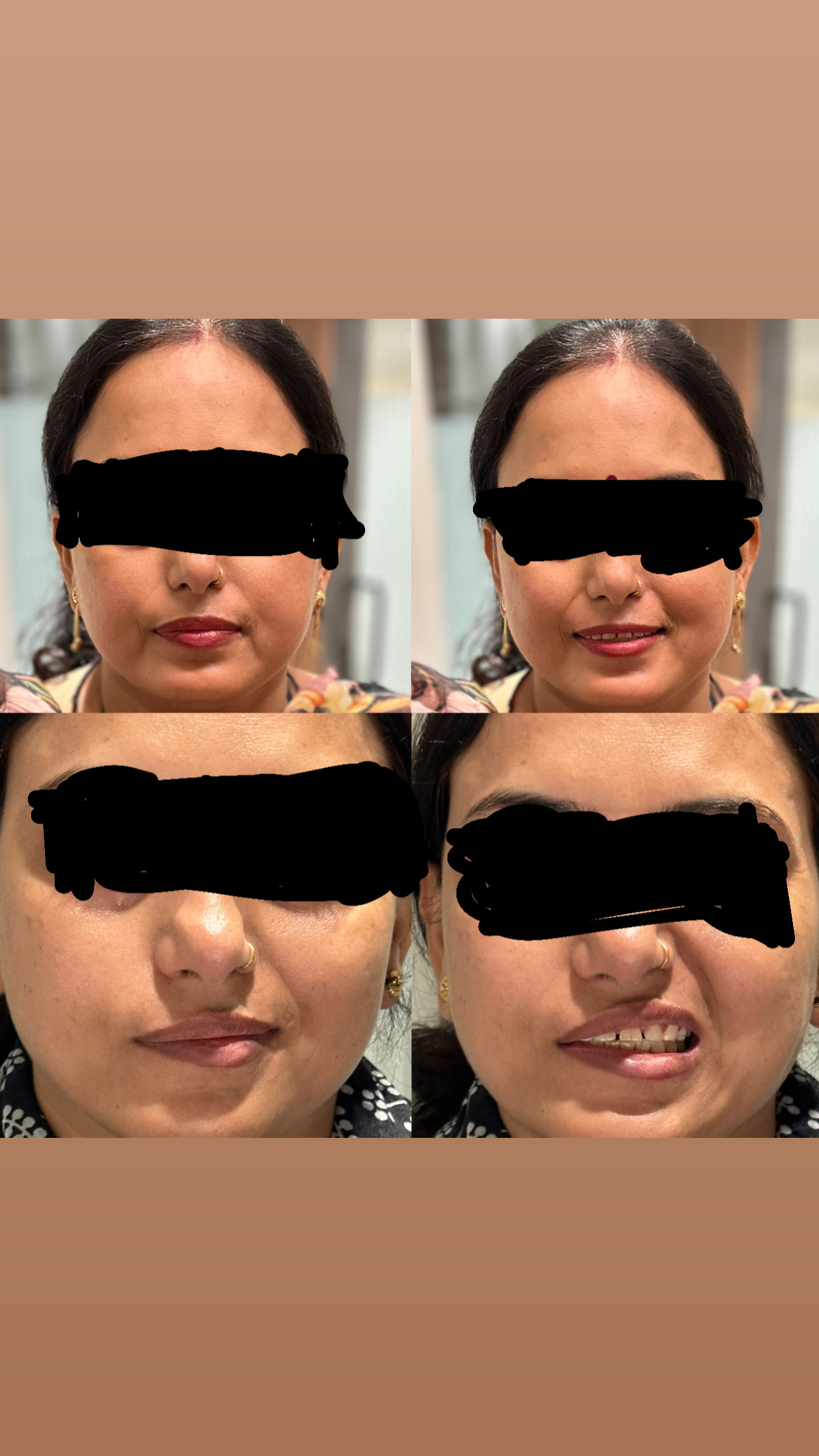
- Incomplete right eye closure (lagophthalmos) — the eye was not shutting fully, leaving the white part visible when she tried to close it
- Absent forehead wrinkling on the right — she could not raise her right eyebrow
- Flattened right nasolabial fold (the crease running from nose to mouth corner — flattened due to muscle weakness)
- Drooping of the right corner of the mouth; deviation of the mouth to the left on smiling
- Bell's phenomenon positive (when attempting to close the eye, the eyeball rolled upward — a protective reflex seen in facial nerve palsy)
- Sensation of the face was intact bilaterally
- Taste sensation mildly reduced on the anterior right side of the tongue
- No signs of ear involvement (no vesicles, no discharge — Ramsay Hunt Syndrome was ruled out clinically)
- Rest of neurological examination: normal — no limb weakness, no speech difficulty, no swallowing issues
Investigations & Findings
A targeted diagnostic workup was initiated to identify any underlying cause, guide antiviral therapy, and rule out serious differentials.
Blood Investigations:
| Test | Result |
|---|---|
| HSV-1 IgG (Herpes Simplex Virus Type 1 antibody) | POSITIVE — indicating prior viral infection/reactivation |
| HSV-2 IgG (Herpes Simplex Virus Type 2 antibody) | Negative |
| VZV IgG (Varicella Zoster — to rule out Ramsay Hunt) | Negative (no active reactivation) |
| CBC (Complete Blood Count) | Within normal limits |
| Blood Sugar (Fasting + PP) | Normal — Diabetes ruled out |
| HbA1c | 5.2% — Normal |
| ESR, CRP | Mildly elevated (non-specific inflammatory markers) |
| ANA, Anti-dsDNA | Negative — Autoimmune cause excluded |
| Liver and Kidney Function | Normal |
| Thyroid Function (TSH) | Normal |
Imaging:
- MRI Brain with contrast (gadolinium-enhanced): No evidence of stroke, cerebellopontine angle tumour, demyelination, or parotid pathology. Subtle enhancement of the facial nerve at the geniculate ganglion region — consistent with inflammatory/viral neuritis. (This means the MRI showed inflammation at the origin of the facial nerve — supporting the diagnosis of Bell's palsy with a viral cause.)
Audiometry: Normal — inner ear function intact.
Diagnosis
Bell's Palsy (Right-sided Idiopathic Peripheral Facial Nerve Palsy) — HSV-1 associated
Bell's palsy is the most common cause of sudden one-sided facial weakness, affecting approximately 20–30 people per 100,000 every year. It results from inflammation and swelling of the 7th cranial nerve (facial nerve) — the nerve responsible for all facial movements on one side.
In this patient, the positive HSV-1 IgG serology along with the MRI finding of geniculate ganglion enhancement pointed strongly towards HSV-1 reactivation as the precipitating trigger — consistent with the well-established viral theory of Bell's palsy.
Differentials considered and excluded:
- Stroke — ruled out (no central signs; forehead involvement present)
- Ramsay Hunt Syndrome — ruled out (no ear vesicles or VZV positivity)
- Lyme neuroborreliosis — no exposure history; serology negative
- Parotid tumour — excluded on MRI
- Guillain-Barré Syndrome — no limb weakness or bilateral involvement
Treatment Approach
Treatment was initiated within 24 hours of symptom onset — a critical window for best outcomes.
1. Antiviral Therapy:
- Valacyclovir 1000 mg three times daily for 7 days — (an oral antiviral medication that works against the Herpes virus family, given to suppress the HSV-1 reactivation driving the nerve inflammation)
2. Corticosteroid Therapy (Anti-inflammatory):
- Methylprednisolone dosed at 1 mg/kg body weight/day (65 mg/day for her weight of 65 kg), tapered over 10 days
- (Steroids reduce swelling around the facial nerve, which is compressed inside a bony canal — reducing the swelling is key to allowing the nerve to recover)
3. Neuroprotective / Supportive Medications:
- Methylcobalamin 1500 mcg daily (active Vitamin B12 — promotes nerve repair and myelin regeneration)
- Alpha Lipoic Acid 600 mg daily (a powerful antioxidant that supports nerve recovery)
- Pantoprazole 40 mg daily (to protect the stomach from steroid-induced acidity)
4. Eye Care (Critical!):
- Lubricating eye drops (0.3% Hydroxypropyl Methylcellulose) every 4 hours during the day
- Eye ointment at night with eye patching — to prevent corneal dryness and injury from incomplete eye closure
- (The eye needs extra protection when it cannot close fully — neglecting this can cause corneal ulceration)
5. Physiotherapy:
- Referral to a neuro-physiotherapist for facial nerve rehabilitation exercises — including mirror-guided facial muscle exercises, neuromuscular retraining, and massage techniques
- Patient was taught a home-exercise routine to perform 3 times daily
Outcome & Follow-Up
At 2-Week Review:
The patient returned visibly brighter and more hopeful. She reported that she was able to close her right eye partially, her smile was beginning to straighten, and she could drink without spillage. House-Brackmann score improved to Grade II (mild dysfunction).
At 4-Week Review (1 Month):
Complete facial symmetry was restored. She could close her eye fully, raise both eyebrows evenly, and her smile was perfectly symmetrical — as documented in her before-and-after clinic photographs. House-Brackmann score: Grade I (Normal function).
The patient's relief and gratitude at her one-month review was deeply moving. "I didn't think I'd smile like this again," she said.
Clinical Pearls / Teaching Points
- 🔑 Time is nerve — Bell's palsy treatment is most effective when started within 72 hours of symptom onset. Antiviral + steroid combination gives the best outcomes.
- 🔑 Always test for HSV — identifying the viral trigger (HSV-1 in this case) helps rationalise antiviral therapy and predict prognosis.
- 🔑 Protect the eye immediately — lagophthalmos (incomplete eye closure) can cause corneal damage if lubricating drops and night patching are not started from day one.
- 🔑 Physiotherapy is not optional — facial nerve exercises significantly reduce recovery time and prevent long-term sequelae like synkinesis (abnormal linked movements of facial muscles during recovery).
- 🔑 Rule out Ramsay Hunt and stroke first — not every facial palsy is Bell's palsy. A careful examination and targeted investigations are essential to avoid missing a more serious diagnosis.
About the Author
This case was managed by Dr. Bhupesh Kumar Mansukhani, MD (Internal Medicine), DM (Neurology) — Neurologist & Director, NeuroMet Wellness Care and Diagnostics, Gurgaon. For appointments: Visit us at
Disclaimer: Patient details have been fully de-identified and this case has been shared with appropriate consent. This case study is intended for educational purposes only and does not constitute individualised medical advice.
References
- Gilden DH. Bell's Palsy. N Engl J Med. 2004;351:1323–1331.
- Baugh RF, et al. Clinical Practice Guideline: Bell's Palsy. Otolaryngol Head Neck Surg. 2013;149(3 Suppl):S1–S27. (AAO-HNS Guidelines)
- Sullivan FM, et al. Early treatment with prednisolone or acyclovir in Bell's palsy. N Engl J Med. 2007;357:1598–1607. (BELLS Trial)
- Engström M, et al. Prednisolone and valaciclovir in Bell's palsy: a randomised, double-blind, placebo-controlled, multicentre trial. Lancet Neurol. 2008;7(11):993–1000.
- Murakami S, et al. Bell palsy and herpes simplex virus: identification of viral DNA in endoneurial fluid and muscle. Ann Intern Med. 1996;124(1 Pt 1):27–30.
- Gronseth GS, Paduga R. Evidence-based guideline update: Steroids and antivirals for Bell palsy. Neurology. 2012;79(22):2209–2213. (AAN Practice Guideline)